
'It is like a chicken-and-egg situation.' 'All these product tweaks are innovative, but traders won't move unless there is liquidity.' 'And liquidity cannot be generated until traders move.'

With new eligibility criteria for futures and options (F&O) coming into effect, Jio Financial Services and Zomato are strong contenders for inclusion in the derivatives segment, according to an analysis by Nuvama Alternative & Quantitative Research. The report suggests that these new F&O inclusions could also propel these two companies into the benchmark National Stock Exchange Nifty 50 during the March rebalancing.

'Sectors like e-commerce, small finance, housing finance, and healthcare are in great favour, and people are paying a PEG ratio of up to 5, which is dangerous.' 'Wealth destruction is inevitable.'

In dollar terms, the Nifty has gained 26.7 per cent in this year, while the Sensex has advanced 25 per cent during the same period.

The index could be vulnerable to a bigger fall given the present market dynamics.

Among the Sensex firms, Larsen & Toubro, Axis Bank, Tata Steel, Bajaj Finance, Power Grid, Asian Paints, Mahindra & Mahindra and Bajaj Finserv were the biggest gainers. State Bank of India, Hindustan Unilever, Tata Motors and Titan were the laggards.


Mini Sensex outdid mini Nifty in turnover on the first day of the New Year. It showed more turnover in terms of value than mini Nifty.

Against the backdrop of a nearly four-hour outage at the National Stock Exchange last month, an RBI article on Friday suggested allowing trading of benchmarks Nifty and Sensex on all stock exchanges. Trading was halted at the NSE for nearly four hours on February 24, reportedly due to telecom links failure leading to unavailability of the online risk management system of the NSE Clearing Ltd (NCL). NCL, a wholly-owned subsidiary of NSE, is responsible for clearing and settlement of all trades executed on the exchange, according to the article.

The National Stock Exchange (NSE) has deferred its plan to change the expiry day of all index and stock derivatives to Monday from Thursday until further notice following markets regulator Sebi's consultation paper. The shift, which was scheduled to take effect on April 4, 2025, would have seen all index and stock derivative contracts move from Thursday to Monday.
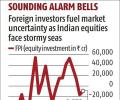
Foreign portfolio investors (FPIs) have withdrawn Rs 25,305 crore from domestic markets since September. FPIs were net sellers in the first two months of 2023, but from March to August, they purchased equities worth Rs 1.7 trillion. This selling trend has caused the National Stock Exchange Nifty Index to decline by 3.2 per cent from its September highs. FPI selling initially began in September as profit-taking but intensified due to rising US bond yields and uncertainty regarding the rate hike trajectory.

The upper market capitalisation (mcap) threshold for midcap and smallcap stocks in the mutual fund (MF) industry's revised list of stocks, to be announced this month, is set to see the second-highest yearly rise in the past five years. The list was first announced in 2018, and it has been revised every six months since then. According to estimates released by Nuvama Alternative & Quantitative Research, the upper threshold for the midcap and smallcap universes could come in at Rs 66,700 crore and Rs 21,900 crore in the next list.
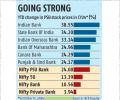
Stock Market News today, PSU banks: The year 2024 was a roller-coaster ride for Indian stock markets, marked by volatility driven by the Lok Sabha elections, Union Budget 2024, a slowdown in corporate earnings, and sticky inflation. Geopolitical tensions - particularly between Israel and Iran in West Asia - along with various stimulus announcements by China and yen carry trade rocked the equity markets throughout the year.
Bombay Stock Exchange, under new CEO Madhu Kannan, wants to re-invent itself. Is it too late?

Mutual funds (MFs) reinforced their record monthly inflows in October with an investment of Rs 87,000 crore (up to October 29), softening the downside pressure on domestic markets. Their prior record for monthly inflows was Rs 48,139 crore in May. This unprecedented monthly buying partially countered record monthly sales by foreign portfolio investors (FPIs) of Rs 1.1 trillion last month.

ICICI Bank, Eternal, Titan, Adani Ports, Tata Consultancy Services and UltraTech Cement were also among the laggards. However, InterGlobe Aviation, Tech Mahindra, Hindustan Unilever and Bajaj Finance were among the gainers.

Mutual funds (MFs) have lined up information technology (IT) funds, indicating that technology stocks are back on fund managers' radar after a hiatus. Over the past 18 months, stock prices for companies in the software space have either corrected or remained subdued. Fund houses have launched five IT-based sectoral funds in the past three months, with three of them taking the passive route.

Actively managed mutual fund (MF) schemes had been at the receiving end over the past few years for their inability to beat their benchmarks. However, the slump in shares of Adani Group companies - two of which are part of the benchmark National Stock Exchange Nifty50 index - have helped them improve their performance vis--vis exchange-traded funds (ETFs) or index funds.

The universe of stocks trading at a 12-month forward price-to-earnings (P/E) multiple of 50x or more has swelled by 2.5x to 104, indicating the growing froth in the market. In March 2023, the number of stocks with a P/E of 50x and 100x stood at 41 and 3, respectively, which has now grown to 104 and 9, according to an analysis by Kotak Institutional Equities (KIE).

The National Stock Exchange (NSE) has withdrawn its decision to change the expiry day for Bank Nifty derivatives contracts from Thursday to Friday. The move follows a "request" from the BSE, which settles its Sensex and Bankex derivatives contracts on Friday. The proposed change in Bank Nifty settlement was scheduled to be effective from July 6 with the first weekly expiry on July 14.
Notwithstanding concerns about lofty valuations, smallcaps recorded their most significant monthly gain in nearly three years in November. The National Stock Exchange Nifty Smallcap 100 finished the month with a 12 per cent gain, the most since February 2021 when it rose by 12.2 per cent. After declining by 4.1 per cent in the preceding month, the Nifty Midcap 100 rose by 10.4 per cent, the most since July 2022.

In US, automatic spending cuts were triggered on Friday as lawmakers failed to agree on a resolution to prevent them, while China's manufacturing growth cooled in February to a four-month low.

Small and midcaps are leading the charge in the latest market rebound. Since November 21, when the benchmark S&P BSE Sensex and the National Stock Exchange Nifty hit their recent lows and slipped into correction territory, the Nifty Smallcap 100 index has risen by 8 per cent, while the Nifty Midcap 100 has gained 5.7 per cent. Meanwhile, the Nifty 50 index has risen by 4.7 per cent during this period.

Positive Asian cues aided risk-on sentiments.
The 30-share Sensex of the Bombay Stock Exchange closed 86.55 points higher at 21,337.67 and the National Stock Exchange Nifty index closed at its highest closing levels in 2014, up 25.15 points at 6,338.95.
Reliance up 0.94%, Sun Pharma up 2.85, ICICI Bank up 0.76%, Bharti Airtel up 1.56% and Tata Steel up 2.2% were the top Sensex gainers today.
Equity funds' exceptional performance was obviously due to the stock market rally that was led by small and mid-cap stocks. Realty, banks and consumer goods companies emerged as top gainers.
National Stock Exchange decided to waive off transaction charges on trades done on its new mini-Nifty, till March 31.
After making its entry into the Bombay Stock Exchange's benchmark 30-share index Sensex in May

Foreign institutional investors have been net investors to the tune of Rs 55,000 crore (Rs 550 billion) in equity markets this year so far. In contrast, domestic institutional investors have been net sellers over the past three months.

SEBI alleges Jane Street placed bets on the stock market falling and then acted in a way to make the market actually fall so it could win its bet.
Last Friday's tumble on Wall Street, with the Dow Jones index falling nearly 400 points, is sure to have its repercussions on the already shaky Indian market. With both the benchmark indices, the Bombay Stock Exchange Sensex and the National Stock Exchange Nifty having lost 5 per cent apiece last week, investors are already skittish.

Stock market regulator Securities & Exchange Board of India (Sebi) has widened the scope of index-based options by allowing exchanges to offer option contracts based on Sensex and Nifty with a tenure of up to five years.

SKS stock has been highly volatile, amid several controversies around the company and the sector.
The Bombay Stock Exchange benchmark Sensex crossed the 21,000 level in early morning trade for the first time on Tuesday on heavy buying by funds.
'The investigation is at a very critical stage. We are not going to give every single document.'

After pumping in close to $20 billion in the preceding five months, foreign portfolio investors (FPIs) have yanked out $220 million from domestic stocks this month. The selling by overseas funds has led to turbulence in the domestic markets, with benchmark indices swinging wildly recently.
